Androids, Electric Sheep, & Public Health: Exploring the soul of AI at the crossroads of technology and public health

“The real question is not whether machines think, but whether men do.”
B.F. Skinner, Contingencies of Reinforcement (1969) ch. 9
What Do Electric Sheep Have To Do With Public Health?
Philip K. Dick’s iconic book, “Do Androids Dream of Electric Sheep?” asks the profound question of whether robots can truly feel empathy. His thought experiment deeply resonates in today’s world where Artificial Intelligence (AI) is advancing rapidly. AI is already capable of tasks that were once in the realm of science fiction such as diagnosing medical conditions by looking at MRIs, writing code, compiling research, and more.
Public health is a multifaceted field that extends beyond just outcomes. It encompasses ethics, equity, and social context to improve communities as a whole. Today, public health asks something similar to Philip Dick: Can AI help us care more equitably, not just calculate more efficiently?
What Public Health Can Learn from Science Fiction
Sci-fi has been warning us about soulless tech for decades. In 2001: Space Odyssey, the artificial intelligence, HAL, is friendly and dependable much like ChatGPT, and even plays chess with humans (Kubrick, 1968). He malfunctions and begins to display negative human characteristics such as deception, aggression, emotional manipulation and eventually values his own self-preservation over the lives of his human crew members (Kubrick, 1968). This movie served as a warning as to what can happen even with good intentions.
Although we may not inhabit the future Space Odyssey predicted, AI already dreams in strange ways—hallucinating patterns and shapes that never existed, a reminder that even our machines are still learning how to see clearly (Salvagno et al., 2023). Right now AI tools like ChatGPT are programmed to promote helpfulness, safety, etc. and are monitored and reinforced by developers (Ouyang et al., 2022). Public health at its core centers human wellbeing over pure efficiency. If healthcare becomes too automated, we can risk losing the person behind the data. AI is currently used in disease surveillance, diagnostics, communication, and health system optimization (Branda et al., 2025; Panteli et al., 2025; Sierra et al., 2025; Wu et al., 2023). What happens when the predictive power of AI outpaces our moral frameworks?
The Promise of AI in Public Health
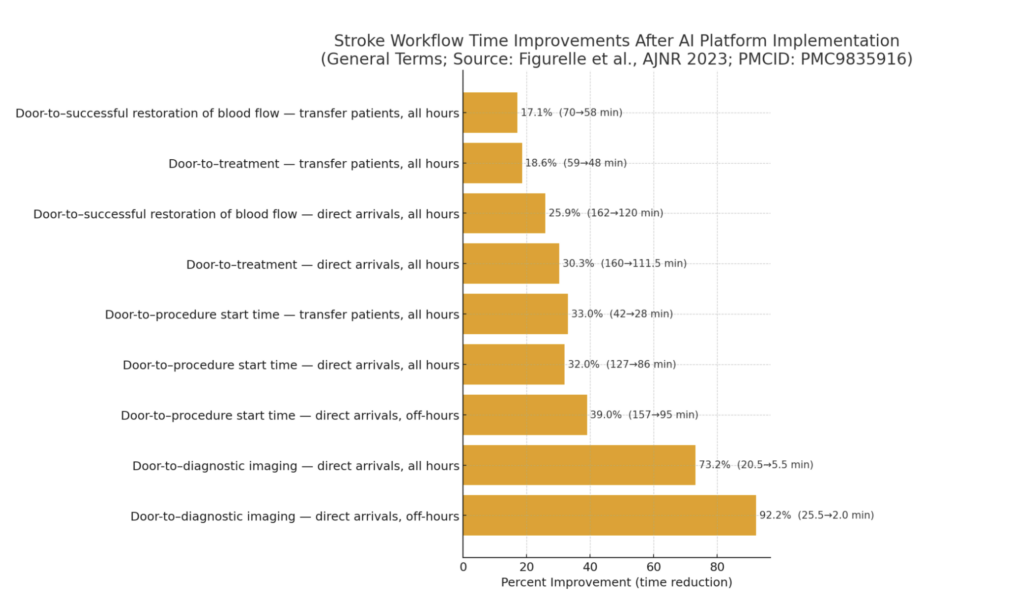
AI is already improving public health outcomes. Hospitals delivering stroke care continually work to reduce the time from when a person starts experiencing stroke symptoms to the time they receive treatment. Every minute care is delayed leads to the death of nearly 2 million brain cells (Saver, 2005). The sooner a patient can receive treatment, the better their outcomes and quality of life will be.
AI was implemented in the workflow to expedite both communication processes and analysis of brain imaging to determine emergency treatment eligibility at a hospital system in San Diego, California. Viz.ai, the AI program implemented automated alerts to the team and assisted in analyzing the diagnostic imaging. Using AI significantly improved the processes and improved times (Figurelle et al., 2022). This will translate into better long term outcomes for the patients since more of their brain function is preserved.
Below is a chart showing how much the metrics improved by using Viz.ai.
The Problem: Bias, Blind Spots, & the Myth of Objectivity (200–250 words)
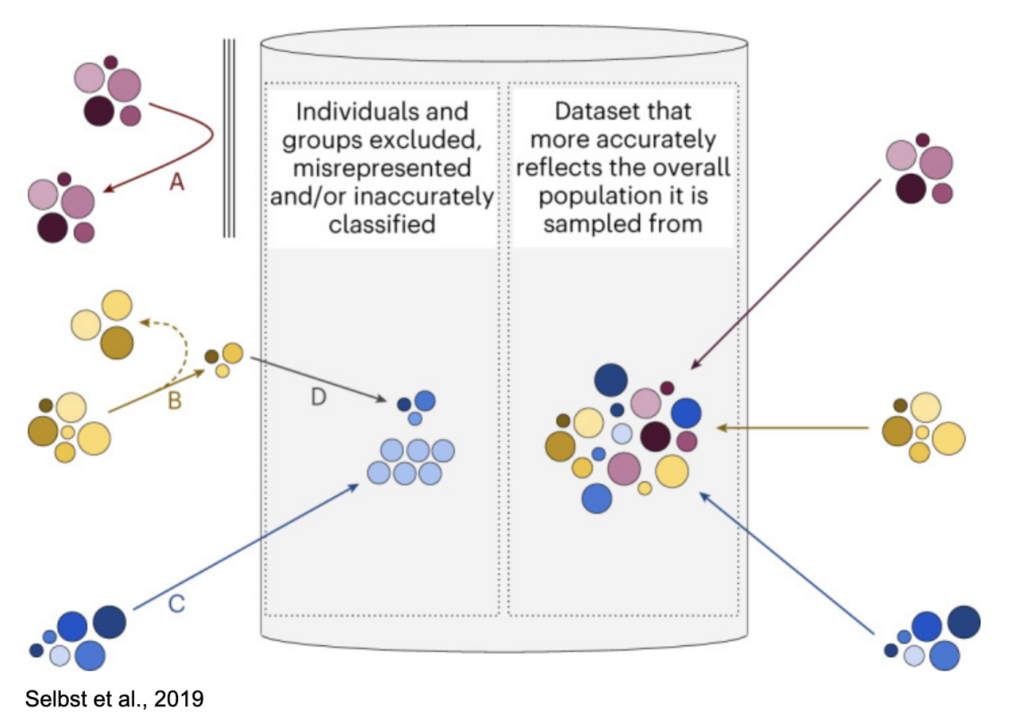
Just like electric sheep, some datasets are artificial—and it matters who’s missing. AI is only as good as the information that it’s trained on. Algorithms are not objective and AI reflects the world it is trained on and its makers, including their biases. Public health work often addresses the social determinants of health to reduce health disparities among different groups within a community (Social Determinants of Health, 2024). Whether intentional or not, the algorithms reflect the designer’s choices and values, potentially creating digital disparities (Selbst et al., 2019). AI can be trained either on incomplete or comprehensive datasets and it will make analysis based on these datasets. If the datasets are inherently flawed then the analysis will be as well.
The equity paradox is when populations who need interventions the most are often excluded from the data that drives programs. Marginalized populations are often already poorly represented in health datasets and training AI using these datasets can exacerbate existing inequities (Marko et al., 2025). The diagram below illustrates how this happens.
Check out the Public Health Insight Podcasts below:
| Intersection of Computer Science & Sociology Part 1 – AI & Public HealthMachine Learning & Natural Language Processing Part 2 – AI & Public Health |
The Solution: Embedding Ethics & Equity by Design
When AI is trained improperly it can create nightmares, but can it be harnessed to create electric dreams for public good? Involving patients and communities in the co-creation of public health AI tools can help bridge gaps in disparities (Donia & Shaw, 2021). Centering the lived experiences of the community members into the data and training reduces the opportunity for groups to be excluded or misrepresented (Donia & Shaw, 2021).
Ongoing governance can help the tools and training evolve along with the community and its needs (Donia & Shaw, 2021). AI has the potential to create a profound impact in the public health domain. External governance is one method of ensuring ethical use, but another method is internal audits (Raji et al., 2020). AI can help monitor itself by performing audits of its own processes spanning the entire lifecycle of its outputs (Raji et al., 2020).
Conclusion: The Soul in the Machine
AI sprung from imaginations purely in the realm of science fiction, but is now part of our everyday lives including how we access health. Algorithms are not flawless and AI has the potential to exacerbate existing problems or be profoundly beneficial depending on how we train and harness it. If androids once dreamt of electric sheep, public health should dare to dream bigger and build tools that amplify care, not just compute it.
Other Related Material
Stroke Centres In England Given AI Tool That Will Help 50% of Patients Recover
Artificial Intelligence, Health Disparities, and Covid-19
Without Small Data, AI in Health Care Contributes to Disparities
Humans Absorb Bias from AI – and Keep it after They Stop Using the Algorithm
References
Arora, A., Alderman, J. E., Palmer, J., Ganapathi, S., Laws, E., McCradden, M. D., Oakden-Rayner, L., Pfohl, S. R., Ghassemi, M., McKay, F., Treanor, D., Rostamzadeh, N., Mateen, B., Gath, J., Adebajo, A. O., Kuku, S., Matin, R., Heller, K., Sapey, E., . . . Liu, X. (2023). The value of standards for health datasets in artificial intelligence-based applications. Nature Medicine, 29(11), 2929–2938. https://doi.org/10.1038/s41591-023-02608-w
Branda, F., Stella, M., Ceccarelli, C., Cabitza, F., Ceccarelli, G., Maruotti, A., Ciccozzi, M., & Scarpa, F. (2025). The role of AI-Based chatbots in Public Health Emergencies: A Narrative review. Future Internet, 17(4), 145. https://doi.org/10.3390/fi17040145
Figurelle, M., Meyer, D., Perrinez, E., Paulson, D., Pannell, J., Santiago-Dieppa, Khalessi, A., Bolar, D., Bykowski, J., & Meyer, B. (2022). Viz.ai Implementation of Stroke Augmented Intelligence and Communications Platform to Improve Indicators and Outcomes for a Comprehensive Stroke Center and Network. American Journal of Neuroradiology, 44(1), 47–53. https://doi.org/10.3174/ajnr.a7716
Donia, J., & Shaw, J. A. (2021). Co-design and ethical artificial intelligence for health: An agenda for critical research and practice. Big Data & Society, 8(2). https://doi.org/10.1177/20539517211065248
Kubrick, S. (Director). (1968). 2001: A space odyssey [Film]. Metro-Goldwyn-Mayer.
Marko, J. G. O., Neagu, C. D., & Anand, P. B. (2025). Examining inclusivity: the use of AI and diverse populations in health and social care: a systematic review. BMC Medical Informatics and Decision Making, 25(1). https://doi.org/10.1186/s12911-025-02884-1
Ouyang, L., Wu, J., Jiang, X., Almeida, D., Wainwright, C. L., Mishkin, P., Zhang, C., Agarwal, S., Slama, K., Ray, A., Schulman, J., Hilton, J., Kelton, F., Miller, L., Simens, M., Askell, A., Welinder, P., Christiano, P., Leike, J., & Lowe, R. (2022, March 4). Training language models to follow instructions with human feedback. arXiv.org. https://arxiv.org/abs/2203.02155
Panteli, D., Adib, K., Buttigieg, S., Goiana-Da-Silva, F., Ladewig, K., Azzopardi-Muscat, N., Figueras, J., Novillo-Ortiz, D., & McKee, M. (2025). Artificial intelligence in public health: promises, challenges, and an agenda for policy makers and public health institutions. The Lancet Public Health. https://doi.org/10.1016/s2468-2667(25)00036-2
Raji, I. D., Partnership on AI, Smart, A., Google, White, R. N., Google, Mitchell, M., Google, Gebru, T., Google, Hutchinson, B., Google, Smith-Loud, J., Google, Theron, D., Google, Barnes, P., & Google. (2020). Closing the AI accountability gap: Defining an End-to-End Framework for internal Algorithmic auditing. In Conference on Fairness, Accountability, and Transparency (FAT* ’20) (p. 12 pages) [Conference-proceeding]. https://dl.acm.org/doi/pdf/10.1145/3351095.3372873
Salvagno, M., Taccone, F. S., & Gerli, A. G. (2023). Artificial intelligence hallucinations. Critical Care, 27(1). https://doi.org/10.1186/s13054-023-04473-y
Saver, J. L. (2005). Time is Brain—Quantified. Stroke, 37(1), 263–266. https://doi.org/10.1161/01.str.0000196957.55928.ab
Selbst, A. D., boyd, d., Friedler, S. A., Venkatasubramanian, S., & Vertesi, J. (2019). Fairness and abstraction in sociotechnical systems. Proceedings of the Conference on Fairness, Accountability, and Transparency (FAT ’19)*, 59–68. Association for Computing Machinery. https://doi.org/10.1145/3287560.3287598
Sierra, N. M., Rincón, E. H. H., Betancourt, G. a. O., Chaparro, P. a. R., Quijano, D. M. D., Barbosa, S. D., Restrepo, M. H., & Sinisterra, G. U. (2025). Use of artificial intelligence in the management of stroke: scoping review. Frontiers in Radiology, 5. https://doi.org/10.3389/fradi.2025.1593397
Social determinants of health. (2024, May 15). Public Health Professionals Gateway. https://www.cdc.gov/public-health-gateway/php/about/social-determinants-of-health.html
Wu, H., Lu, X., & Wang, H. (2023). The application of artificial intelligence in health care resource allocation before and during the COVID-19 Pandemic: Scoping review. JMIR AI, 2, e38397. https://doi.org/10.2196/38397
Written by: Joya Banerjee, MPH, RN