The Missing Metric in Public Health? Happiness.

Written by Joya Banerjee, MPH, RN
“The fundamental reason why most of us aren’t as happy as we could be is that we allocate attention in ways that are often at odds with experiencing as much pleasure and purpose as we could .”
– Paul Dolan, Professor of Behavioral Science at the London School of Economics and Political Science
Redefining Well-being: Why Public Health Needs Happiness Data
At its essence, public health is about cultivating healthy communities and promoting wellbeing. Individuals are the foundation of communities and what makes people thrive at their very core is happiness.
People think the ingredients to happiness are things like wealth, power, success, good health, relationships, social class, et cetera if you ask them what contributes to happiness — not public health considerations.
What if public health cared as much about happiness as it does about communicable diseases? Could measuring and reporting well-being ultimately improve population health? We’ll explore: how economists are measuring joy, the midlife crisis, public health interventions for happiness, the happiest demographic, and one country’s secret for happiness.
From QALY to WELLBY: Making Happiness a Public Health Metric
The Public Health Insight Podcast team spoke with Paul Dolan, a behavioral scientist known for his expertise on happiness and public policy. Happiness is linked to overall well-being including physical and mental health outcomes (The First Federal Measure of Overall Well-Being Is Here, but What Does It Mean? – News & Events | odphp.health.gov, n.d.).
Happiness is not a metric that governments or public health organizations measure to assess well-being, but Paul believes it should be since happiness is paramount to our quality of life.
Currently, economists and public health professionals do not directly consider happiness, but they do measure quality and quantity of life with the QALY (Quality Adjusted Life Years) system (Cookson et al., 2020) whereby 1 QALY is equal to 1 year of life in “perfect” health.
For example, if one person lives through one year in perfect health and her friend lives through the same year, but with a debilitating disease, their QALYs are not the same. Even though they both lived through the same amount of time, their quality of life is vastly different.
Often, governments use QALYs to shape public health policy (Thokala et al., 2020). Dolan proposes we consider WELLBYs which are similar to QALYs except they are focused on subjective well-being instead of only health (Brazier & Tsuchiya, 2015).
The chart below shows how QALYs compare to WELLBYs.
| Measure | QALY | WELLBY |
| What it measures | Mental and physical health quality | Subjective well-being (life satisfaction) |
| Unit of Measure | Years lived adjusted by health state | Years lived adjusted by well-being |
| Application | Evaluating cost-effectiveness of healthcare | Evaluating policy impacts on happiness |
| Outcome type | Health related quality of life | Life satisfaction over time |
Listen to Public Health Insight’s Podcasts with Dr. Dolan below:
The Midlife Crisis: Myth or Measured Reality?
All of us have heard the midlife crisis stereotype: a middle aged man, usually in his 40s or 50s, trying to re-claim his fading youth by making drastic life changes and buying sports cars. (Notably, there is no stereotypical midlife crisis for women though they experience it too).
Is this just entertainment fodder or is there something actually to it? Turns out, it’s not just fiction. Global studies including developed and developing nations have shown that people experience more subjective happiness in early adulthood, with a decline in middle age (40s – 50s), and then an upswing in their later years (Blanchflower, 2020; Laaksonen, 2016).
This graph illustrates this phenomenon
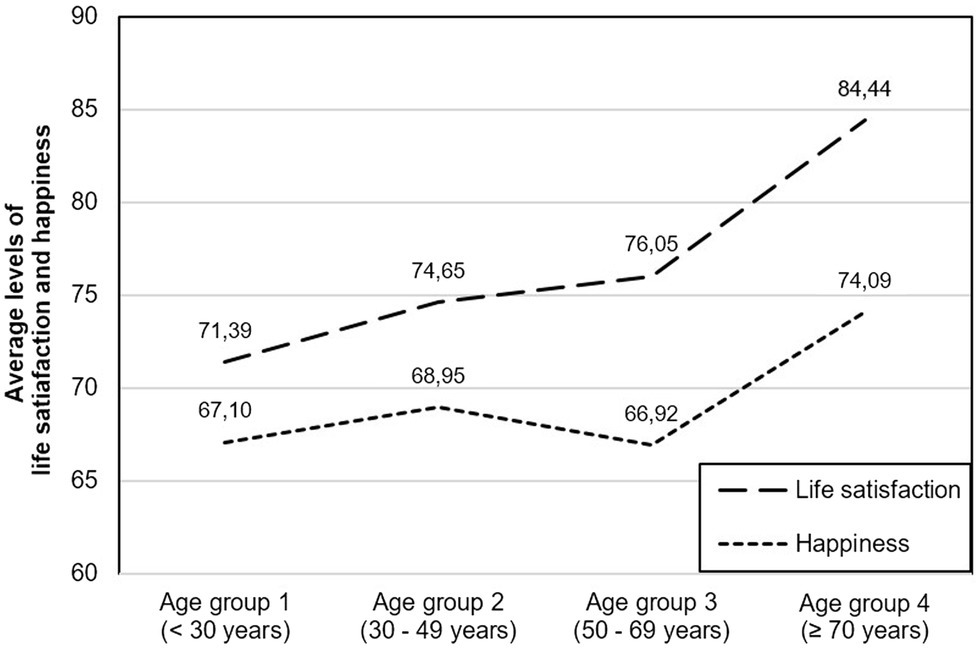
Karwetzky et al. (2022)
What causes the midlife slump? Young adults tend to be overly optimistic about their futures, but midlife is when reality sets in that they will have unmet dreams and aspirations (Schwandt et al., 2015). This leads to disappointment and potential regret about missed opportunities.
In addition, this is the time of life where career pressure is high and adults can be caring for both young children and older adults so stress levels can be at their peak leading to the midlife slump (Blanchflower & Graham, 2021). However, around age 50, this changes as adults adjust their expectations to the reality of life as it is and happiness rises.
Single Crazy Cat Ladies: The Happiest Demographic
The old trope of the single crazy cat lady is as well known as men having a midlife crisis. US Vice President, JD Vance, brought this into the spotlight when, in an interview, he commented that “a bunch of childless cat ladies who are miserable at their own lives and the choices that they’ve made … want to make the rest of the country miserable as well” (Treisman, 2024).
He could not have been more wrong. Women who remain unmarried without children report life-satisfactions scores that either match or exceed every other demographic group (Bień et al., 2017; Stahnke et al., 2020). They might actually be the happiest demographic.
So, why is this? Meta-analyses show that wives do more caregiving and obtain less health and sexual benefits from marriage than husbands, eroding the average well-being payoff of partnership for women (Holt-Lunstad 2008; Pew 2021).
Unmarried women also maintain rich social networks instead of relying on one person and they often avoid the expectation-reality gap that fuels dissatisfaction for other demographics (Hoan & MacDonald 2024; DePaulo 2023 review; Schwandt 2016 unmet-aspirations model). Despite the stigma, this group is living the good life.
Evidence-Based Interventions to Boost Happiness
Happiness is modifiable at every societal layer and combining individual skill-building, supportive workplaces, and public policies can have the strong impact on overall well-being.
Individual Level Interventions
- Increasing social connection: Increasing social connection adds meaning and purpose, reduces loneliness, and increases feelings of emotional support & belonging (Kim et al., 2020; Martino et al., 2015; Nakada et al., 2024). These factors directly lead to increased life satisfaction.
- Mindfulness: Mindfulness training is associated with better emotional regulation allowing people to adopt better coping skills and correlated with increased subjective well-being (Keng et al., 2011).
Workplace / Corporate Interventions
- Flexible work arrangements: when workers have greater control over their schedules they report both higher life satisfaction, job satisfaction, and lower burnout so this is beneficial for both the worker and the company (Guoqiang & Bhaumik, 2024)
- Employee Well-being programs: Companies with programs that address stress-management, peer-support, etc. have shown to have lower turnover and higher employee satisfactions scores (Headquarters, 2010).
Government Level Policies
- WELLBY approach: Consistently tracking and monitoring changes in WELLBYs can offer insight into the life-satisfaction of a country’s people as a whole. Promoting policies that support increases in WELLBYs can have a positive impact.
Bhutan’s Secret for Happiness
According to Bhutan’s Gross National Happiness Survey, over 90% of Bhutanese residents report they are either “deeply, extensively, or narrowly happy” (Centre for Bhutan Studies & GNH Research, 2016).
What’s Bhutan’s secret? Regularly contemplating death.
Death seems counterintuitive for increasing happiness, but the regular reminders of the impermanence of life reduces fear of dying, and highlights ordinary everyday joys (Namdul, 2025). The cultural tradition of Bhutanese Buddhists to contemplate mortality encourages gratitude, pro-social behavior, and emotional resilience — all behaviors that lead to greater life satisfaction and happiness.
What approaches do you think are best for increasing happiness?
Other Related Material
Bhutan’s Dark Secret to Happiness
The Simple Secret to Happiness
The Surprising Way Mindfulness Makes You Happier
Why So Many Single Women Without Children Are Happy
References
Bień, A., Rzońca, E., Iwanowicz-Palus, G., Lecyk, U., & Bojar, I. (2017). The quality of life and satisfaction with life of women who are childless by choice. Annals of Agricultural and Environmental Medicine, 24(2), 250–253. https://doi.org/10.5604/12321966.1235181
Brazier, J., & Tsuchiya, A. (2015). Improving Cross-Sector comparisons: Going beyond the Health-Related QALY. Applied Health Economics and Health Policy, 13(6), 557–565. https://doi.org/10.1007/s40258-015-0194-1
Blanchflower, D. G. (2020). Is happiness U-shaped everywhere? Age and subjective well-being in 145 countries. Journal of Population Economics, 34(2), 575–624. https://doi.org/10.1007/s00148-020-00797-z
Centre for Bhutan Studies & GNH Research. (2016). A compass towards a just and harmonious society: 2015 GNH survey report. Centre for Bhutan Studies & GNH Research. https://base.socioeco.org/docs/2015gnhsurveyreport.pdf
Cookson, R., Skarda, I., Cotton‐Barratt, O., Adler, M., Asaria, M., & Ord, T. (2020). Quality adjusted life years based on health and consumption: A summary wellbeing measure for cross‐sectoral economic evaluation. Health Economics, 30(1), 70–85. https://doi.org/10.1002/hec.4177
DePaulo, B. (2023). Single and flourishing: Transcending the deficit narratives of single life. Journal of Family Theory & Review, 15(3), 389–411. https://doi.org/10.1111/jftr.12525
Guoqiang, Z., & Bhaumik, A. (2024). WORK-LIFE HARMONY AND RETENTION OF EMPLOYEES: A REVIEW OF THE IMPACT OF FLEXIBLE WORK ARRANGEMENTS. Deleted Journal, 02(02), 31–38. https://doi.org/10.62674/ijabmr.2024.v2i02.005
Karwetzky, C., Michaelsen, M. M., Werdecker, L., & Esch, T. (2022). The U-Curve of Happiness Revisited: Correlations and Differences in Life Satisfaction Over the Span of Life—An empirical evaluation based on data from 1,597 individuals aged 12–94 in Germany. Frontiers in Psychology, 13. https://doi.org/10.3389/fpsyg.2022.837638
Keng, S., Smoski, M. J., & Robins, C. J. (2011). Effects of mindfulness on psychological health: A review of empirical studies. Clinical Psychology Review, 31(6), 1041–1056. https://doi.org/10.1016/j.cpr.2011.04.006
Kim, E. S., Whillans, A. V., Lee, M. T., Chen, Y., & VanderWeele, T. J. (2020). Volunteering and Subsequent Health and Well-Being in Older Adults: An Outcome-Wide Longitudinal Approach. American Journal of Preventive Medicine, 59(2), 176–186. https://doi.org/10.1016/j.amepre.2020.03.004
Headquarters, W. (2010, May 19). WHO healthy workplace framework and model. https://www.who.int/publications/i/item/who-healthy-workplace-framework-and-model
Hoan, E., & MacDonald, G. (2024). “Sisters are doin’ it for Themselves”: Gender Differences in Singles’ Well-Being. Social Psychological and Personality Science. https://doi.org/10.1177/19485506241287960
Holt-Lunstad, J., Birmingham, W., & Jones, B. Q. (2008). Is There Something Unique about Marriage? The Relative Impact of Marital Status, Relationship Quality, and Network Social Support on Ambulatory Blood Pressure and Mental Health. Annals of Behavioral Medicine, 35(2), 239–244. https://doi.org/10.1007/s12160-008-9018-y
Laaksonen, S. (2016). A Research Note: Happiness by Age is More Complex than U-Shaped. Journal of Happiness Studies. https://doi.org/10.1007/s10902-016-9830-1
Martino, J., Pegg, J., & Frates, E. P. (2015). The connection prescription: Using the power of social interactions and the deep desire for connectedness to empower health and wellness. American Journal of Lifestyle Medicine, 11(6), 466–475. https://doi.org/10.1177/1559827615608788
Mitchell, T., & Mitchell, T. (2025, April 24). Rising share of U.S. adults are living without a spouse or partner. Pew Research Center. https://www.pewresearch.org/social-trends/2021/10/05/rising-share-of-u-s-adults-are-living-without-a-spouse-or-partner/
Nakada, T., Kozawa, T., Seino, S., Murota, S., Eto, M., Shimasawa, J., Shimizu, Y., Tsurugano, S., Katsukawa, F., Sakamoto, K., Washizaki, H., Ishigaki, Y., Sakamoto, M., Takadama, K., Yanai, K., Matsuo, O., Kameue, C., Suzuki, H., Kurotani, K., & Ohkawara, K. (2024). A Community-Based Intervention to Enhance Subjective Well-Being in Older Adults: Study design and baseline participant profiles. Healthcare, 12(3), 322. https://doi.org/10.3390/healthcare12030322
Namdul, T. (2025). Death and Happiness: Exploring the temporalities of the meditated death and everyday life in Tibetan Buddhist practice of Tukdam. Culture Medicine and Psychiatry. https://doi.org/10.1007/s11013-025-09914-7
The first Federal Measure of Overall Well-Being is here, but what does it mean? – News & Events | odphp.health.gov. (n.d.). https://odphp.health.gov/news/202307/first-federal-measure-overall-well-being-here-what-does-it-mean
Schwandt, H., Department of Economics, University of Zurich and Center for Economic Performance, London School of Economics, Princeton, Universitat Pompeu Fabra, University of Hamburg, & University of Zurich. (2015). Unmet aspirations as an explanation for the age u-shape in wellbeing [Journal-article]. https://bpb-us-e1.wpmucdn.com/sites.northwestern.edu/dist/1/3630/files/2023/05/Unmet_Aspirations.pdf
Schwandt, H. (2015). Unmet aspirations as an explanation for the age U-shape in wellbeing. Journal of Economic Behavior & Organization, 122, 75–87. https://doi.org/10.1016/j.jebo.2015.11.011
Stahnke, B., Blackstone, A., & Howard, H. (2020). Lived experiences and life satisfaction of ChildFree women in late life. The Family Journal, 28(2), 159–167. https://doi.org/10.1177/1066480720911611
Thokala, P., Carlson, J. J., & Drummond, M. (2020). HTA’d in the USA: A Comparison of ICER in the United States with NICE in England and Wales. Journal of Managed Care & Specialty Pharmacy, 26(9), 1162–1170. https://doi.org/10.18553/jmcp.2020.26.9.1162
Treisman, R. (2024, July 29). JD Vance went viral for ‘cat lady’ comments. The centuries-old trope has a long tail. NPR. https://www.npr.org/2024/07/29/nx-s1-5055616/jd-vance-childless-cat-lady-history